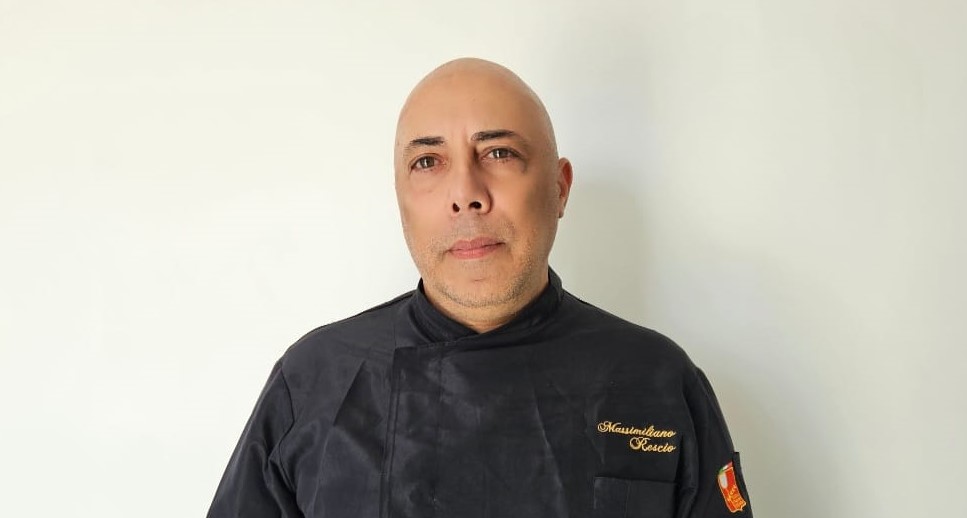
Massimiliano Rescio, 59, originally from Bari in Puglia, trained and graduated from the Italian School of Pizza Makers. For years he has been a standard-bearer for the world of pizza, making it his profession and rising to the level of spreading pizza culture through his position as a tutor and trainer in some of the most renowned training schools in the specific field of pizza.
His wide professional and teaching experience is even more relevant today, in the year that Italian cuisine has been recognized as UNESCO Cultural Heritage. However, it should be noted that his role as a promoter of Italian culture is also important, as today more than ever, this culture needs to be highlighted.
Max Rescio, who has lived in Bangkok for several years, has worked extensively abroad, in Egypt, Luxembourg, Saudi Arabia, South Africa, Thailand, Switzerland, and Austria. He also worked with Conrad Gallagher Michelin Stars Chef and Nikolaus Deuleg prestigious Italian kitchen director.
We interview him while he is working in Norway at one of the most prestigious local tourist and accommodation facilities in Tjorholm in Sirdal, on the Norwegian ski slopes of South Tjorholmfjellet, Sirdal Lodge Restaurant.
Nowadays, pizza can be found in every corner of the world and is adapted to local characteristics and tastes. It originated in Italy and spread throughout the world. What is your opinion on this? Do you prefer to maintain the original Italian identity or are you open to locally introduced variations?
Pizza is one of the most recognizable symbols of Italian gastronomic culture, and I firmly believe that it is essential to preserve its original identity, especially in its essential elements: the quality of the ingredients, which must be Italian, starting with the flour, the technique used to prepare the dough, and respect for traditions. However, I am also aware that cuisine is a universal language that is constantly evolving. Cultural influences can enrich the product, as long as they do not distort its essence. I am in favor of local interpretations of pizza, provided that there is respect for its history and the principles that make it unique.
In the world of pizza and its related industries, what is your personal philosophy, what is your specific plan?
My philosophy is based on three pillars: authenticity, continuous training, and adaptability. I believe that a good pizza maker must have a thorough understanding of the roots of Italian tradition, but also be ready to innovate, experiment, and adapt to the cultural and gastronomic contexts in which they operate. My plans focus on spreading the culture of artisan pizza around the world by training young pizza makers, consulting for international restaurants, and promoting techniques such as long rising times and the use of highly digestible dough. I want to be a bridge between Italian tradition and the contemporary needs of the food industry.
Creating a gourmet pizza is an art that is expressed through the use of high-quality ingredients and advanced processing techniques. To obtain a final product that reflects the excellence of Italian gastronomic tradition, it is essential to start with a solid foundation: the choice of flour. Choice of Flour Let's start with the flour. A type “0” or “1” flour is ideal for ensuring a higher presence of minerals and bran, which enrich the flavor and give the pizza a distinctive note. The choice of flour is not only a matter of taste, but also of health: more integrated flours provide essential nutrients that reflect the adoption of a healthy and conscious cuisine.
The use of diastatic malt is another crucial step. This ingredient in the pizza dough starter promotes more stable and vigorous fermentation, feeding the yeast with simple sugars derived from the breakdown of starches thanks to enzymes (diastase), ensuring greater strength in the dough, better air pockets, and a more golden and flavorful bake.
It is essential in indirect doughs, such as biga, to prevent the yeast from exhausting the available sugars too quickly, stabilizing the leavening process over time.
Biga, a pre-ferment that exudes quality, must be prepared with care: it is essential to respect the resting and fermentation times to ensure maximum flavor development. Regarding hydration and processing techniques: hydration ranging from 65% to 80% allows for an elastic dough, and with the appropriate kneading techniques, it is ideal for giving pizza lightness and flavor.
However, to achieve these levels, it is important to have the right tools, such as a refrigerator dedicated exclusively to pizza dough. Using a “biga holder” can help maintain the ideal temperature during rising, preserving the organoleptic characteristics of the dough.
What are your future plans and what advice would you give to someone who wants to pursue a career similar to yours?
One of my future projects is to open an international academy for pizza chefs, where I can pass on not only the techniques but also the values and passion behind this profession. I am also working on a series of digital content to share my know-how with a wider audience, including video tutorials and collaborations with international chefs.
RIPRODUZIONE RISERVATA © Copyright Prima Notizia 24